
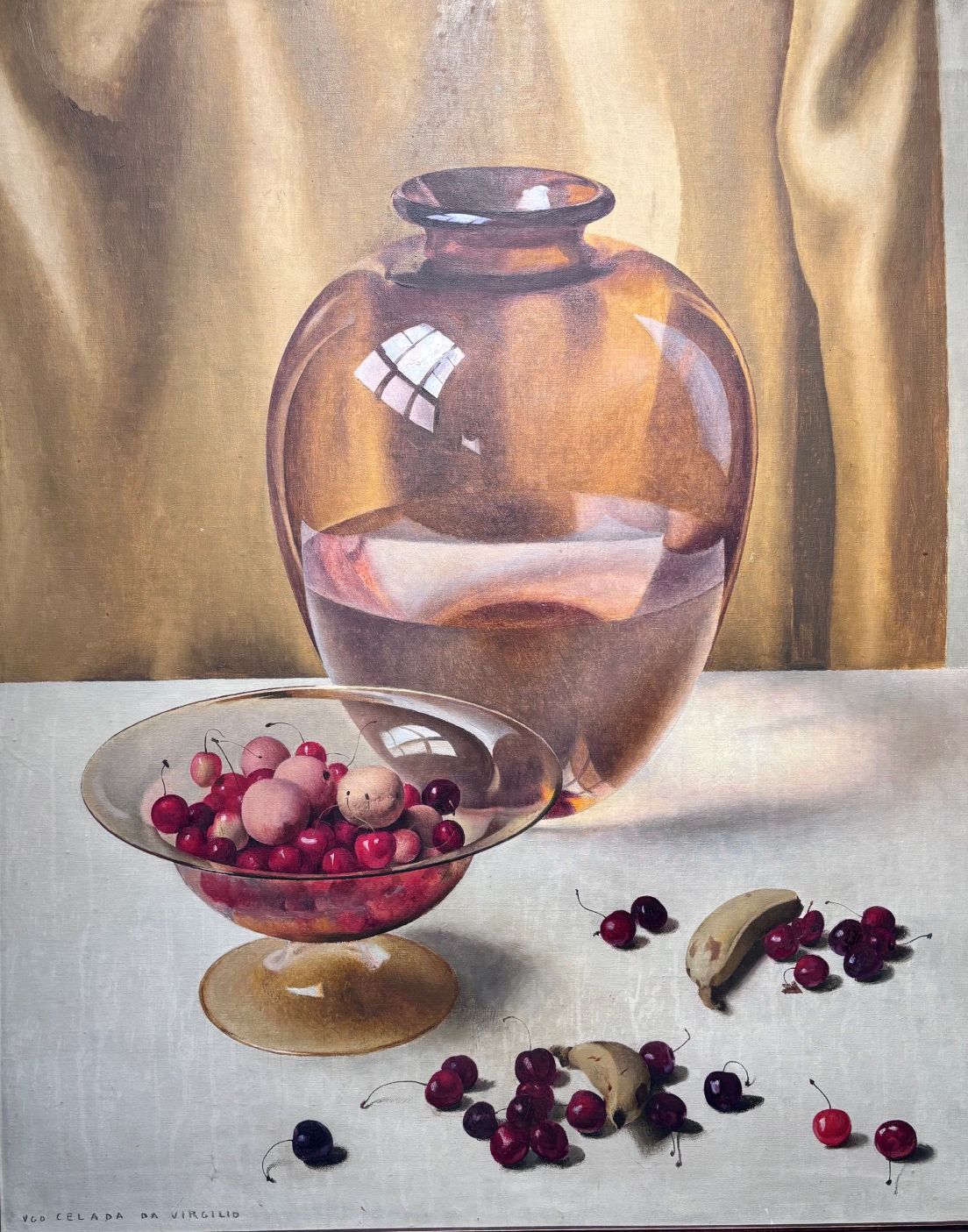
Ugo CELADA (Cerese di Virgilio, Mantua 1895 - Varese 1995)
Born in Cerese di Virgilio, a small town near Mantua, he drew so well as a child that he convinced his father to enroll him, at just twelve years old, in the Royal School of Applied Arts in Mantua. From there, thanks to a scholarship, he went on to study at the Brera Academy, where he particularly appreciated the lessons of the painter Cesare Tallone, a painter of remarkably expressive portraits. In 1914, he volunteered for the front, where he was employed as a military mapmaker thanks to his precise lines. Upon returning from the war, he decided to move to Paris, after a stay in Genoa as a guest of the Della Ca’ family, that purchased some of his works. His official art debut, under the name Ugo Celada da Virgilio, took place at the 1920 Venice Biennale. His paintings, characterized by an obsessive, almost photographic realism, similar to the style of Cagnaccio di San Pietro and Antonio Donghi, met with critical and public acclaim. Celada was invited to the 1924 and 1926 editions, earning considerable critical acclaim. Thanks to his growing success, exhibition invitations became more frequent. He left Paris, moved to Milan, and presented his paintings first at the Turin Quadriennale and then at the Permanente in Milan. In 1930, he exhibited at the Galleria Samadei in a group show alongside other painters of the Novecento movement, supported by Margherita Sarfatti. But his dissent with the group, and especially his signature on the Anti-Novecento Manifesto, which denounced the regime’s monopoly on culture and was published in the periodical Il Regime Fascista, proved fatal to his career, which had begun so quickly and brilliantly. Celada was isolated and never invited to public exhibitions again, living off portrait commissions from well-known members of the Milanese bourgeoisie, who appreciated his style. In 1943, during the bombing of Piazza Cinque Giornate, his studio was destroyed along with all its works. Isolated and reclusive, he moved to Varese in the late 1950s, where he died at the age of 100 and forgotten. His painting began to be rediscovered in 1985 thanks to the opening of the permanent collection of the Museo Virgiliano di Pietole, which houses a donation of 56 works by the painter. Among the unjustly forgotten of art, his work has been the subject of a growing and constant revaluation.
MUSEUMS
Museo di Pietole, Mantova – Collezione Ugo Celada da Virgilio